
Free Lease Agreement Template (Word & PDF): Fill and Sign
Free Lease Agreement Template (Word & PDF): Fill It In and Sign It Online
Summary of the Article
Below you get a complete free residential lease agreement template you can turn into a Word (.docx) file or a PDF in about two minutes, plus a section-by-section guide to filling it out. You can also download a ready-made government PDF form right away if you prefer not to build the file yourself. The template works for simple, single-family rentals; many states require extra disclosures or a state-specific form, so check your state's rules before signing. Once the lease is filled in, you can sign it online free with an e-signature tool like SignFree.
- The template: paste into Word or Google Docs, then download as a .docx or export as PDF.
- Instant PDF option: Oklahoma's basic residential lease form is a real, downloadable PDF you can use as-is or as a comparison.
- What to fill in: parties, property, term, rent, deposit, utilities, maintenance, and termination terms.
- State law matters: deposit caps, notice periods, and required disclosures vary by state.
- Signing: e-signatures on leases are valid under federal ESIGN and state UETA laws.
- This article is educational, not legal advice. For a complex property or a rent-controlled city, talk to a local attorney or use your state landlord association's form.
What a Residential Lease Agreement Actually Is
A residential lease agreement is the contract between a landlord and a tenant. It sets the rent, the length of the stay, who pays for what, and how either side can end the arrangement. If you rent out a room, a house, or a small unit, you need one in writing. A handshake agreement gives you almost nothing if a dispute shows up later.
A generic template is appropriate when the rental is straightforward: one tenant or a couple, a normal single-family home or apartment, and no unusual terms. If your property sits in a rent-controlled city, a subsidized-housing program, or a state with strict disclosure rules, use a form built for your state instead. The links at the end of this article show where to find those.
For comparison, you can also look at how other services structure their lease templates, such as DocuSign's free lease agreement template and sample rental format or Zillow Rental Manager's lease agreements for rentals. Do not copy another company's template word for word; use the structure below and adapt it.
Free Lease Agreement Template: Get It as a Word File or PDF
This page provides the template itself. Here is how to get it as the two file types the headline promises:
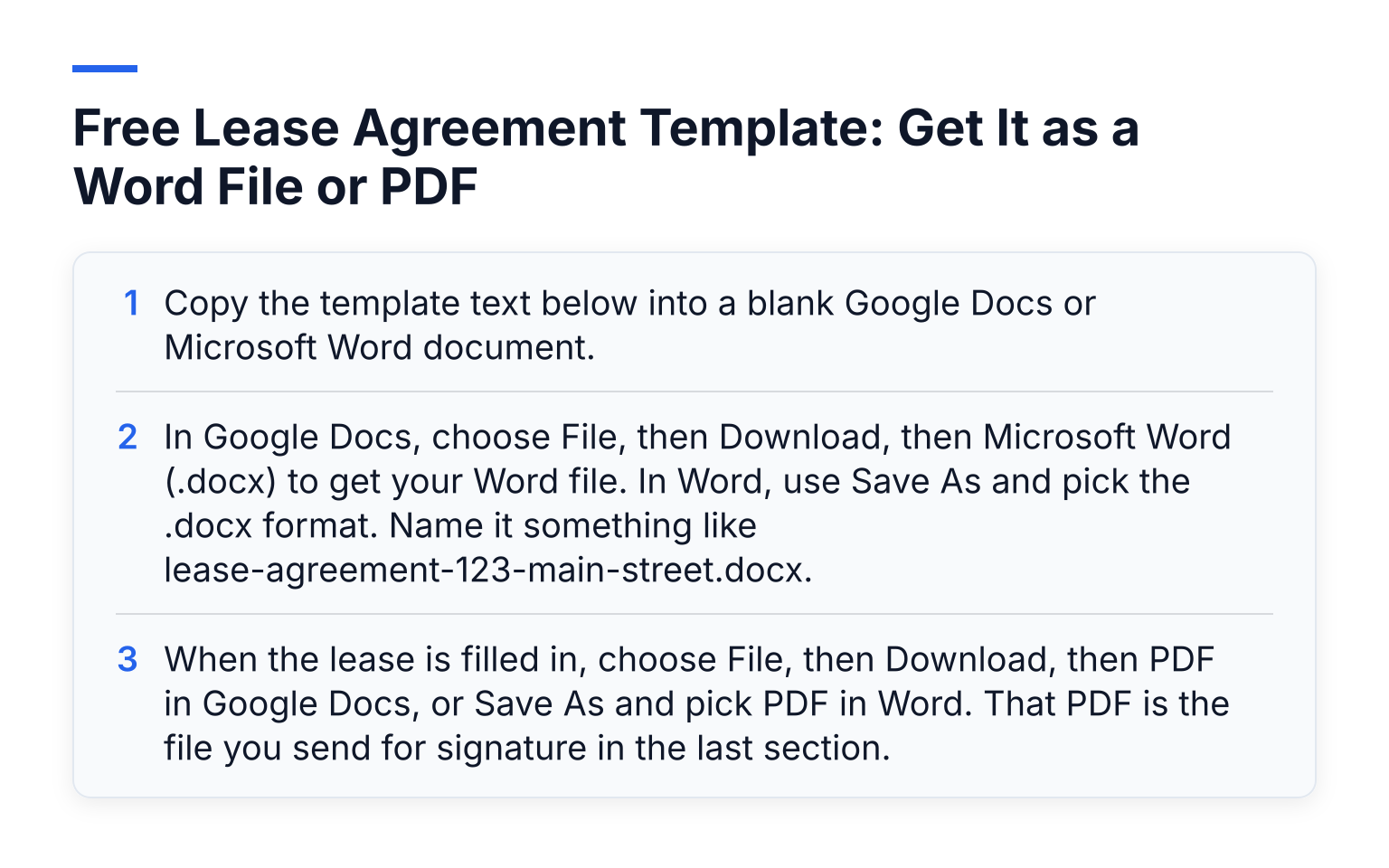
- Copy the template text below into a blank Google Docs or Microsoft Word document.
- In Google Docs, choose File, then Download, then Microsoft Word (.docx) to get your Word file. In Word, use Save As and pick the .docx format. Name it something like
lease-agreement-123-main-street.docx. - When the lease is filled in, choose File, then Download, then PDF in Google Docs, or Save As and pick PDF in Word. That PDF is the file you send for signature in the last section.
If you would rather download a finished form instead of building one, Oklahoma's Department of Commerce publishes a free Basic Rental Agreement or Residential Lease PDF you can open and download immediately. Compare it with the version below and you will see the same core sections: parties, premises, term, rent, deposit, utilities, and signatures.
Nothing in this template is a SignFree feature. This page provides the text; SignFree is only the signing step covered later.
RESIDENTIAL LEASE AGREEMENT

1. PARTIES
This Residential Lease Agreement ("Agreement") is made on [DATE]
between [LANDLORD FULL NAME] ("Landlord") and
[TENANT FULL NAME(S)] ("Tenant").

2. PREMISES
Landlord leases to Tenant the residential property located at
[STREET ADDRESS, CITY, STATE, ZIP], including [parking/storage/
appliances included, if any].

3. TERM
The lease term begins on [START DATE] and ends on [END DATE].
 Upon expiration, the tenancy converts to [month-to-month /
requires a new signed agreement], unless the parties agree otherwise in writing.

4. RENT
Tenant agrees to pay monthly rent of $[AMOUNT], due on the [DAY] of each
month, payable to [PAYMENT METHOD AND PAYEE]. Rent is late after the
[DAY] of the month. A late fee of $[AMOUNT] applies only if permitted
by state law.

5. SECURITY DEPOSIT
Tenant pays a security deposit of $[AMOUNT] on or before [DATE].
State law limits deposits in some states; Landlord will comply with
applicable state law on deposit limits, holding, interest, and return.

6. UTILITIES
Tenant pays: [electricity, gas, water, trash, internet].
Landlord pays: [list].

7. MAINTENANCE AND REPAIRS
Tenant will keep the premises clean, promptly report damage, and not
make alterations without written consent. Landlord will maintain the
premises in compliance with applicable habitability laws.

8. USE AND OCCUPANCY
The premises are for residential use only. Occupants: [NAMES].
Smoking: [permitted/prohibited]. Pets: [none permitted / describe
pet terms and any pet deposit].

9. TERMINATION AND NOTICE
To end a month-to-month tenancy, either party must give written notice
of at least [NUMBER] days, or the minimum required by state law,
whichever is greater. Fixed-term leases end on the end date unless
renewed in writing. Early termination terms: [describe, if any].

10. ENTRY
Landlord may enter with at least [NUMBER] hours'/days' notice, or as
state law permits, for repairs, inspection, or emergencies.

11. DEFAULT
If Tenant breaches this Agreement and fails to cure after written
notice as required by law, Landlord may pursue the remedies available
under applicable state law.

12. GOVERNING LAW AND ADDITIONAL TERMS
This Agreement is governed by the laws of the state of [STATE].
Additional terms or addenda required by state or local law are attached
and initialed by both parties.

SIGNATURES
Landlord signature: __________________ Date: ________
Tenant signature: __________________ Date: ________
Tenant signature: __________________ Date: ________
Section-by-Section: What to Fill In and What People Get Wrong
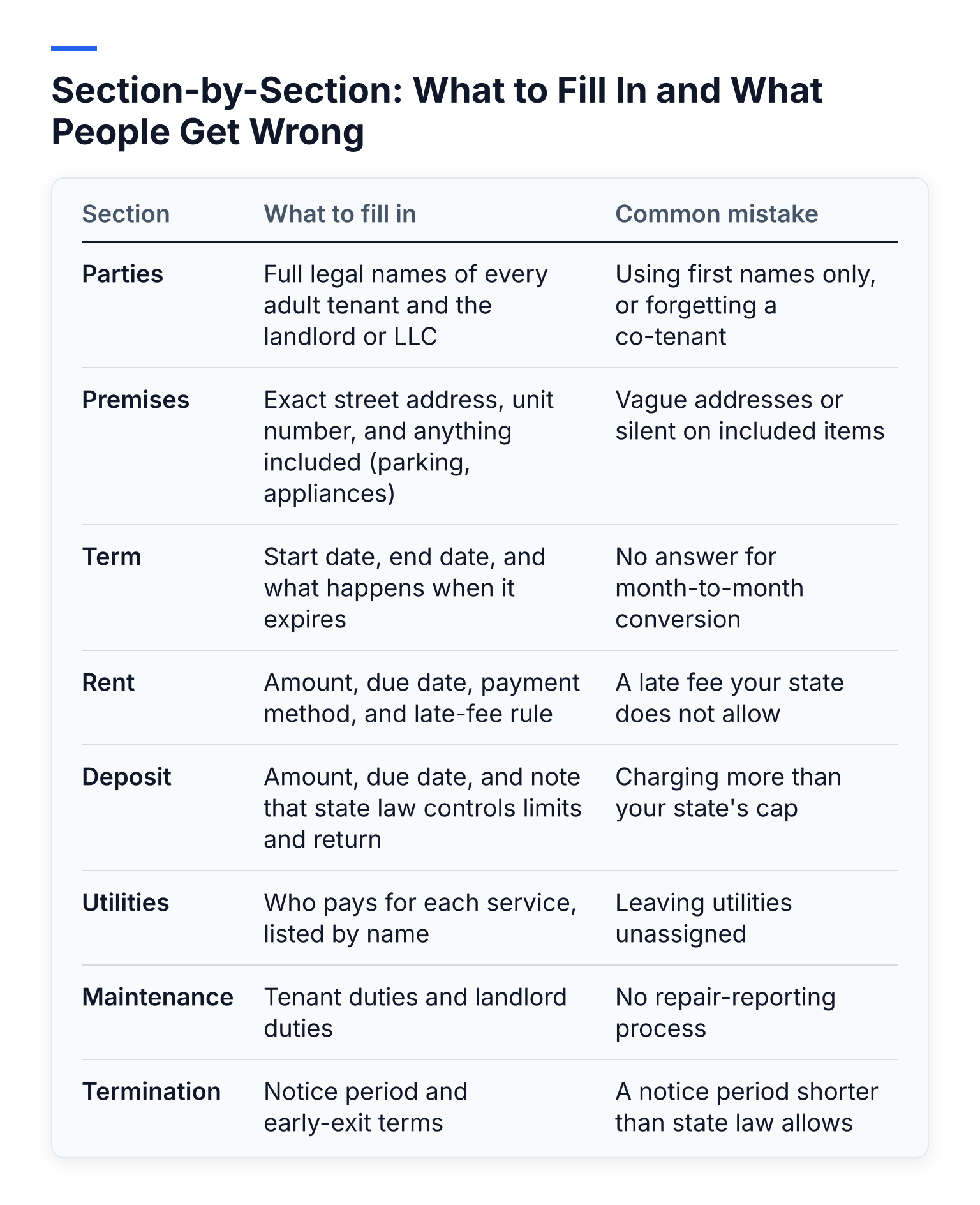
| Section | What to fill in | Common mistake |
|---|---|---|
| Parties | Full legal names of every adult tenant and the landlord or LLC | Using first names only, or forgetting a co-tenant |
| Premises | Exact street address, unit number, and anything included (parking, appliances) | Vague addresses or silent on included items |
| Term | Start date, end date, and what happens when it expires | No answer for month-to-month conversion |
| Rent | Amount, due date, payment method, and late-fee rule | A late fee your state does not allow |
| Deposit | Amount, due date, and note that state law controls limits and return | Charging more than your state's cap |
| Utilities | Who pays for each service, listed by name | Leaving utilities unassigned |
| Maintenance | Tenant duties and landlord duties | No repair-reporting process |
| Termination | Notice period and early-exit terms | A notice period shorter than state law allows |
Clauses That Commonly Cause Disputes
Three clauses start most landlord-tenant fights, and all three are controlled by state law more than by your template:
- Security deposits. Many states cap the amount, require interest or escrow, and set a strict deadline for returning the deposit. For example, Nolo's state-by-state security deposit statutes guide shows how much the rules differ, and Texas law requires refund within 30 days after the tenant surrenders the premises. Check your state statute, not your neighboring state's rules.
- Notice periods. Month-to-month tenancies usually need 30 days' notice, but some states require more or differ by how long the tenant has lived there. Put the state minimum in your lease, not a number you remember from somewhere else.
- Late fees. Many states limit late fees or the grace period before one applies. If your fee exceeds the limit, that clause may be unenforceable even though both of you signed it.
The safe pattern: write "the greater of [number] days or the minimum required by state law." That keeps the template valid even if the law changes.
What a Template Cannot Do
Be honest with yourself about the limits of a free lease agreement form:
- Required state disclosures. Many states require lead-paint disclosures (federal law for pre-1978 housing), Megan's Law notices, flood zone disclosures, or other addenda. A generic template does not include these automatically.
- Local ordinances. Cities with rent control or just-cause eviction rules often override what your lease says. New York State, for example, caps deposits at one month's rent for most units under General Obligations Law § 7-108, no matter what the lease states.
- Unusual situations. Roommates with separate obligations, rent-to-own terms, or commercial use do not fit a residential template.
If any of these apply, use your state landlord association's form or consult a local attorney. The cost of one legal review is small next to a single eviction dispute.
Fixed-Term vs. Month-to-Month: Which to Choose
A fixed-term lease (usually 6 or 12 months) locks in the rent and the tenant for the whole period. Choose it when you want predictable income and can absorb the risk of a tenant who stops paying but stays until the term ends.
A month-to-month agreement renews automatically each month and either side can end it with proper notice. Choose it for uncertainty: a house you might sell, a tenant you have not rented to before, or seasonal markets.
Section 3 of the template asks you to pick. Do not leave it blank; that ambiguity is what the rest of the document then has to guess around.
How to Fill Out the Template Correctly
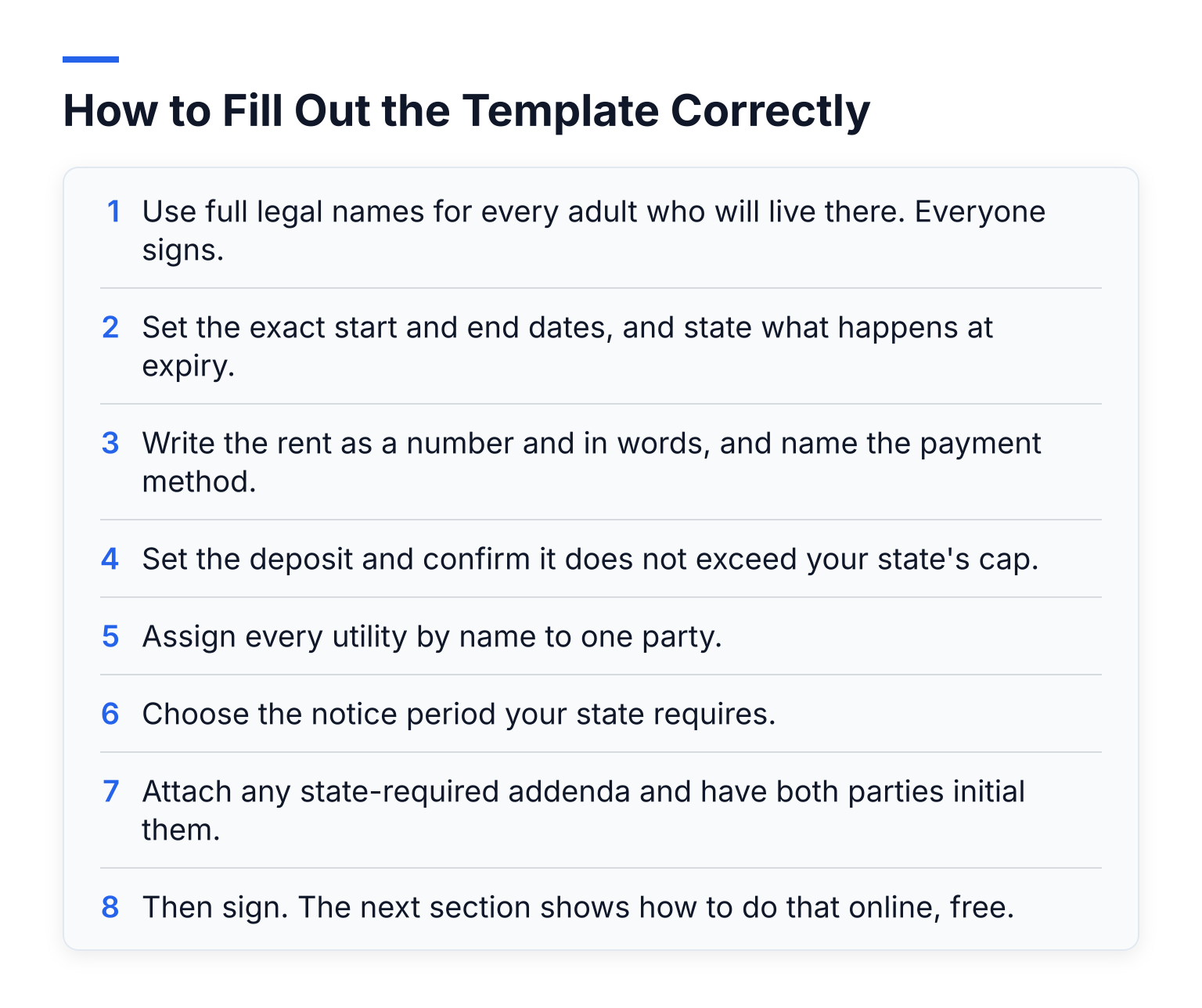
- Use full legal names for every adult who will live there. Everyone signs.
- Set the exact start and end dates, and state what happens at expiry.
- Write the rent as a number and in words, and name the payment method.
- Set the deposit and confirm it does not exceed your state's cap.
- Assign every utility by name to one party.
- Choose the notice period your state requires.
- Attach any state-required addenda and have both parties initial them.
- Then sign. The next section shows how to do that online, free.
How to Get the Lease Signed Online Free (With SignFree)
Once the lease is filled in and saved as a PDF, you can sign it without printing anything. SignFree is an e-signature platform for solo entrepreneurs and lean teams, and signing real-estate leases and disclosures is one of its core use cases.
The workflow takes a few minutes:
- Upload the completed lease PDF to SignFree.
- Add signers, the landlord and every adult tenant. Signers do not need accounts.
- Place signature and date fields where the template's signature lines sit.
- Send for signature. Everyone signs in the browser.
- Track completion and download the signed copy, which comes with an audit trail showing when and how each signature happened.
The Free plan is unlimited for one-person businesses, so a solo landlord can send leases, renewals, and disclosures all month without a meter. If you want the full walkthrough, the help guide how to send a document for signature covers each click, and the real-estate page at SignFree's free e-signature for real estate covers lease-specific details.
Are E-Signatures on Leases Legal?
Yes, in general. The federal ESIGN Act, 15 U.S.C. § 7001, says a signature or contract cannot be denied legal effect just because it is electronic, and most states have adopted the Uniform Electronic Transactions Act (UETA) with similar rules. Both apply to residential leases. Two things to respect: both parties must agree to conduct the transaction electronically, and you must keep a copy of the signed lease both parties can access and reproduce. SignFree's audit trail and downloadable signed copy cover the retention side. For how different signature levels and compliance requirements work, see SignFree's e-sign compliance overview.
Notarization is a separate question. Most states do not require a residential lease to be notarized, but a few require or offer optional notarization, and some require recording. Check your state, because this is exactly the kind of rule a generic template cannot know for you.
FAQ
Can I write my own rental agreement? Yes. A lease you write yourself is enforceable as long as it meets state law and includes the required disclosures. The template above gives you the standard structure so you do not miss a section.
Is a Word template legally valid? The format does not matter; the content and signatures do. A lease signed in Word, PDF, or on paper has the same standing if the terms comply with state law. Keep the signed copy somewhere both parties can retrieve it.
Does a lease need to be notarized? Usually not. Most states treat a residential lease as a simple contract that needs signatures, not notarization. A handful of exceptions exist, so verify with your state or local housing office.
Where do I get state-specific forms? State landlord associations, state housing agencies, and form libraries are the best sources. DocuSign's lease agreement template page and Zillow Rental Manager's lease agreements also organize templates by state; use them to cross-check what your state requires before you sign anything.
Next Step
Copy the template into Word or Google Docs, fill in the brackets, download it as a .docx or export it as a PDF, and then create a free SignFree account or start signing free to get it signed today. If you also sign client contracts and other documents as part of your work, the same free account covers those too; see how a freelancer or consultant can go paperless without adding another subscription or grab a free consulting contract template while you are at it.
Disclaimer: This article is for general education only and is not legal advice. Lease requirements vary by state and city. Consult a licensed attorney or your state landlord association for advice on your specific situation.